
Adrenaline, Tunnel Vision, and the Psychology of Police Shootings
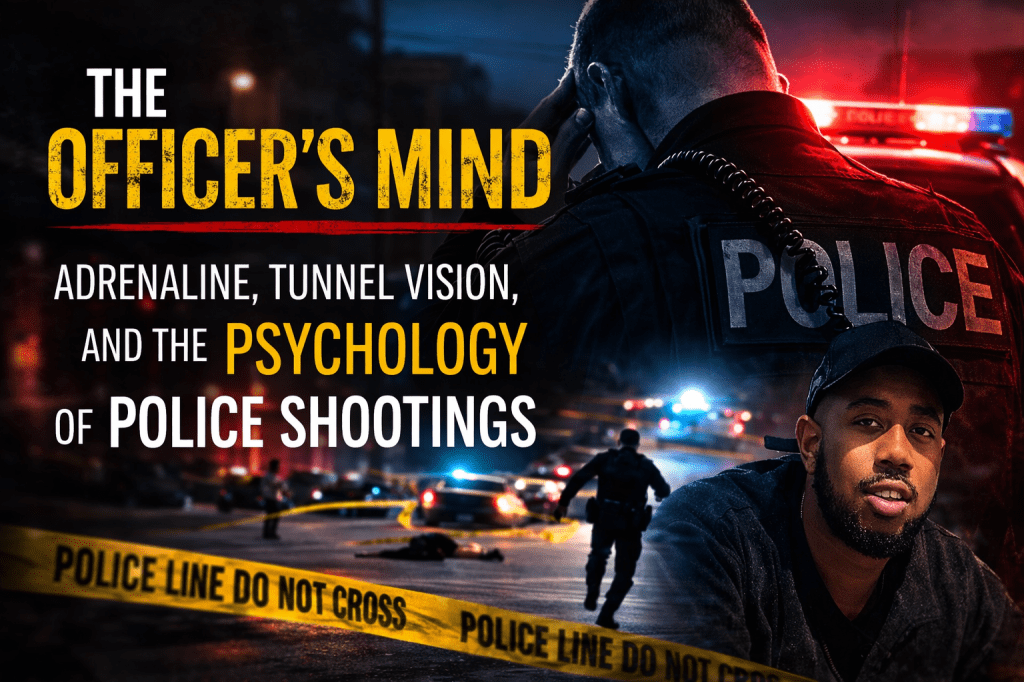
When a police officer pulls the trigger, the public usually sees the moment in stark, simple terms: a shot fired, a life ended, a decision made in seconds.
But inside the officer’s mind, the experience is rarely simple.
Modern research in psychology, neuroscience, and policing shows that officers involved in violent encounters often experience dramatic physiological changes that affect perception, judgment, and memory. In high-threat environments, the brain’s survival systems take over, producing powerful stress responses that can narrow attention, distort time, and alter how threats are perceived.
These effects—commonly described as adrenaline surge, tunnel vision, and threat fixation—are now widely studied in law enforcement training and post-incident analysis.
Understanding those psychological factors is essential when examining controversial police shootings. It does not determine guilt or innocence. But it can help explain how an officer might perceive a threat that others never saw—or react with deadly force in situations that appear, in hindsight, avoidable.
The fatal shooting of Donovon Lynch at the Virginia Beach Oceanfront in March 2021 raises precisely those questions.
Because by the time Officer Solomon Simmons encountered Lynch, he had already spent nearly half an hour responding to one of the most chaotic policing environments imaginable: multiple shootings, injured civilians, fleeing crowds, and officers sprinting toward active gunfire.
In such circumstances, the human brain does not operate the way it does in calm conditions.
It shifts into survival mode.
What Happens to the Brain Under Extreme Stress
When humans perceive a life-threatening situation, the body activates the fight-or-flight response, a physiological process controlled primarily by the amygdala and the sympathetic nervous system.
Within seconds:
- Adrenaline floods the bloodstream
- Heart rate can spike above 150 beats per minute
- Blood flow shifts toward large muscle groups
- Fine motor skills begin to degrade
- Cognitive processing narrows toward perceived threats
Police trainers often describe this state as “sympathetic nervous system dominance.”
It is designed to keep a person alive in a violent encounter.
But it comes with consequences.
Under extreme stress, people frequently experience:
- Tunnel vision – focus narrows toward a perceived threat while other information is filtered out
- Auditory exclusion – certain sounds become muted or disappear entirely
- Time distortion – events seem to slow down or accelerate
- Memory fragmentation – recall after the event may be incomplete or altered
These effects are well documented in both military and law enforcement research.
In other words, what an officer perceives in a high-stress moment may not match what bystanders see—or even what the officer later remembers.
Tunnel Vision and Threat Fixation
One of the most studied phenomena in officer-involved shootings is tunnel vision, sometimes called threat fixation.
When the brain identifies a possible threat, it focuses attention almost exclusively on that object.
Peripheral awareness decreases dramatically.
Officers may miss visual details outside their immediate focus—even details that appear obvious to observers.
In some documented cases, officers have fired their weapons while failing to notice:
- additional officers nearby
- bystanders standing in the open
- objects unrelated to the threat
- other individuals moving around them
The brain essentially prioritizes survival information over everything else.
In training environments, instructors often attempt to mitigate tunnel vision by teaching officers to scan and reassess threats before firing.
But in real-world encounters lasting only seconds, tunnel vision can still dominate perception.
Auditory Distortion
Another common stress response is auditory exclusion.
Officers involved in shootings frequently report not hearing gunshots, commands, or other loud noises that were clearly audible to witnesses.
Conversely, they may report hearing sounds—such as mechanical weapon noises—that others nearby did not notice.
This phenomenon occurs because the brain selectively filters sensory input during extreme stress.
For example, an officer might hear the metallic sound of a weapon manipulation while simultaneously failing to register surrounding noise such as sirens or shouting.
Whether such perceptions reflect accurate observations or stress-induced misinterpretations can be difficult to determine after the fact.
The Adrenaline Cascade
Police shootings are often analyzed as isolated events lasting only seconds.
But in many cases, the officer involved has already been exposed to multiple stress triggers before the final encounter.
This is sometimes called a cumulative stress cascade.
Each successive threat increases physiological stress levels.
Heart rate rises.
Adrenaline builds.
Cognitive narrowing intensifies.
By the time the final confrontation occurs, the officer may be operating under extreme physiological strain.
Some experts compare this state to a short-term combat response.
The body is primed for survival, not deliberation.
The Virginia Beach Oceanfront Context
The events leading up to the shooting of Donovon Lynch illustrate how such cumulative stress might occur.
On March 26, 2021, the Virginia Beach Oceanfront experienced a series of violent incidents in rapid succession.
First, gunfire erupted near Atlantic Avenue, leaving multiple victims wounded.
Officer Solomon Simmons was among the first responders.
According to investigative records, Simmons assisted a wounded civilian and briefly followed an ambulance transporting the victim.
Shortly afterward, a second shooting broke out near Pacific Avenue.
Witnesses reported dozens of gunshots.
Police vehicles rushed toward the scene.
Crowds scattered in every direction.
During this second incident, an officer was struck by a vehicle attempting to flee the area.
Simmons, who had been nearby, abandoned his patrol vehicle and ran toward the gunfire.
Within minutes he encountered Donovon Lynch.
By that point, Simmons had experienced:
- an active shooting scene
- injured civilians
- emergency medical response
- a second major shooting
- dozens of gunshots
- a fellow officer injured
Each event increased the stress load on responding officers.
When Simmons encountered Lynch, his body may already have been operating at a heightened state of alert.
The Split-Second Decision Problem
Law enforcement officers are trained to make rapid threat assessments.
But under extreme stress, those assessments can be influenced by cognitive shortcuts known as heuristics.
The brain attempts to quickly categorize ambiguous situations based on prior experience or perceived danger.
If an officer expects armed threats in a chaotic environment, ambiguous cues can be interpreted as confirmation of that threat.
This does not necessarily mean the threat was real.
But it explains how officers can perceive danger even when witnesses later report seeing none.
In such situations, the brain prioritizes survival over uncertainty.
The Limits of Training
Modern police training attempts to prepare officers for these psychological effects.
Departments emphasize:
- stress inoculation training
- scenario-based simulations
- tactical communication
- de-escalation techniques
The goal is to teach officers to slow down their decision-making under stress and evaluate threats more carefully.
But training cannot eliminate physiological responses.
Even highly experienced officers can experience tunnel vision, auditory distortion, and threat fixation.
This reality has been recognized in both military and law enforcement research for decades.
The Question of Officer Wellness
Because of these stress responses, many departments now require psychological evaluation and counseling after officer-involved shootings.
Such evaluations serve several purposes:
- assessing the officer’s mental health
- identifying trauma exposure
- determining readiness to return to duty
However, details of those evaluations are often confidential.
In many cases the public never learns whether they occurred.
That lack of transparency can fuel ongoing questions about controversial incidents.
Understanding Without Excusing
The psychology of police shootings is often misunderstood.
Explaining how stress affects perception does not automatically justify the use of deadly force.
But ignoring those psychological factors can also lead to incomplete analysis.
Investigators, prosecutors, and courts must often evaluate an officer’s actions based on what the officer reasonably perceived at the time—not solely on what later evidence shows.
That distinction lies at the heart of many controversial police shootings.
What an officer believed they saw.
Versus what actually happened.
Why These Questions Matter
The killing of Donovon Lynch remains deeply painful for his family and friends.
He was not accused of participating in the earlier shootings that night.
He was walking with a friend, trying to return to his car after a chaotic evening.
Yet he became the only person killed by police during the Oceanfront incidents.
Understanding the psychological conditions under which Officer Simmons made his decision does not answer every question in the case.
But it may help explain how two people—one a frightened officer, the other an unsuspecting civilian—could collide in a deadly moment during a night of chaos.
Five years later, those seconds remain the subject of intense debate.
And they serve as a reminder that behind every police shooting lies not only a legal investigation—but also a complex human story unfolding inside the mind of the officer who pulled the trigger.
 The Donovon Lynch Case