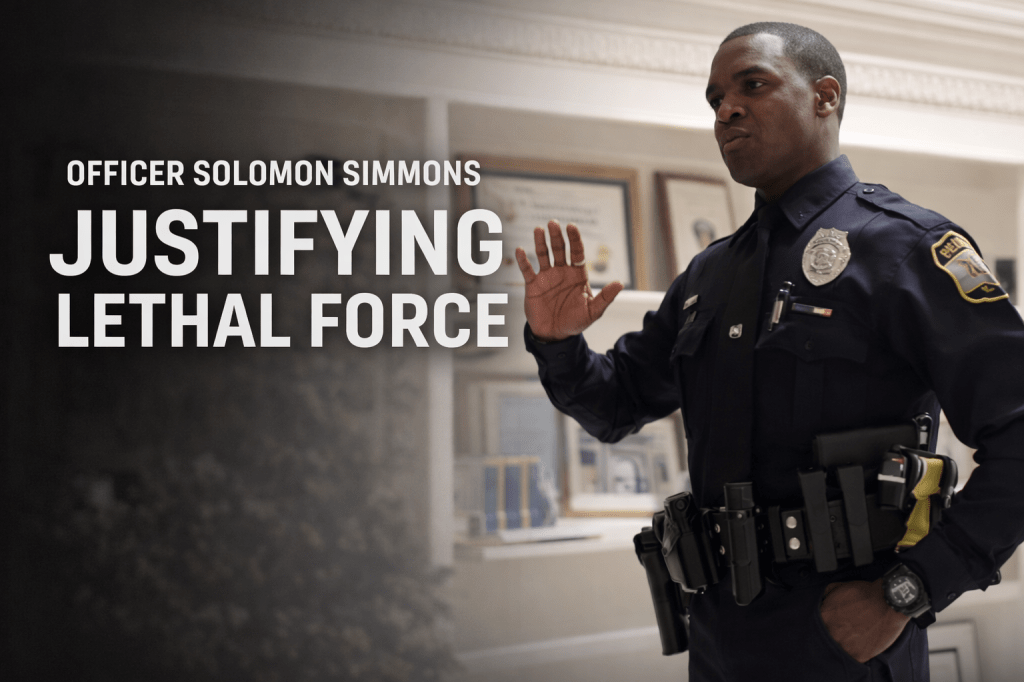
On March 26, 2021, during a chaotic night of multiple shootings at the Virginia Beach Oceanfront, Officer Solomon Simmons shot and killed 25-year-old Donovon Lynch.
The legal justification for that use of force—accepted by investigators and later by a Special Grand Jury—rests almost entirely on Simmons’ own account of what he perceived in a matter of seconds.
But that account, and the circumstances surrounding it, raise critical questions about what happened, what can be proven, and what remains unknowable.
Simmons’ Stated Justification: A Split-Second Threat Assessment
According to his official statements and legal filings, Officer Simmons justified the shooting based on a claim of immediate and imminent danger.
His account follows a clear sequence:
- He was responding to an active and unfolding shooting scene
- He heard what he believed was the sound of a handgun slide being racked
- He turned toward the sound and observed Donovon Lynch crouched behind shrubbery
- He called out toward Lynch
- Lynch allegedly stood up, turned toward him, and pointed a firearm in his direction
At that point, Simmons states he believed:
- Lynch posed a threat of serious bodily harm or death
- There was no time to issue a warning
- There were no viable alternatives to lethal force
He ultimately concluded that his actions were:
- Objectively reasonable
- Taken in self-defense
- Taken in defense of others, including nearby officers and civilians
This framing aligns closely with the legal standard governing police use of force—whether an officer’s actions were reasonable under the circumstances as they perceived them in the moment.
The Context: A Night of Chaos
Simmons’ justification cannot be separated from the broader conditions that night.
The Oceanfront was experiencing:
- Multiple separate shooting incidents
- Large, uncontrolled crowds
- Ongoing gunfire across different locations
- Reports of violence involving both civilians and officers
Earlier that evening, Simmons had:
- Responded to a shooting near Nightmare Mansion on Atlantic Avenue
- Provided aid to a gunshot victim
- Followed an ambulance transporting that victim to Sentara Virginia Beach General Hospital
By his own account, he returned to an environment he already understood to be volatile and dangerous.
This context is central to his defense.
He argues that:
- He was operating in a rapidly evolving, high-risk environment
- He had recent firsthand exposure to gun violence
- His perception of threat was shaped by real, ongoing danger—not speculation
The Critical Gap: No Body Camera Footage
One of the most significant factors in evaluating Simmons’ justification is what does not exist:
There is no body camera footage of the shooting.
Evidence and expert analysis confirm:
- Simmons had deactivated his body camera earlier in the evening
- He did not reactivate it before encountering Lynch
- He did not activate it immediately after the shooting
In his legal response, Simmons admits this outright.
His justification:
- His focus was entirely on responding to an active threat
- He was moving toward the sound of gunfire
- Activating the camera was not feasible under the circumstances
But the absence of footage has profound implications.
Without it:
- There is no direct visual record of the encounter
- No confirmation of Lynch’s movements or positioning
- No verification of whether a warning was given
- No objective evidence of the alleged pointing of a weapon
Instead, the justification rests almost entirely on:
- Simmons’ testimony
- Physical evidence recovered after the fact
- Investigative interpretation
The Legal Standard: “Objective Reasonableness”
At the core of Simmons’ defense is a key legal principle:
Police use of force is judged based on what a reasonable officer would do in the same situation, not with hindsight.
Under this standard:
- Officers are not required to be correct—only reasonable
- Decisions can be justified even if later evidence complicates the narrative
- Split-second judgments in dangerous situations are given significant deference
Simmons’ claim fits squarely within this framework:
- He perceived a lethal threat
- He acted immediately
- He had no time to verify or reassess
The Special Grand Jury ultimately concluded that his actions met this standard and declined to bring charges.
Where the Justification Becomes Contested
While the legal framework supports Simmons’ justification, the factual foundation remains disputed or incomplete in key areas.
1. The Sound of a “Racking” Handgun
Simmons claims he heard a distinct and recognizable sound.
Questions remain:
- Was that sound independently verified?
- Could it have originated from another source in a chaotic environment?
- Did other officers report hearing the same thing?
2. Lynch’s Position and Movement
The justification hinges on a critical moment:
That Lynch stood, turned, and pointed a weapon.
But without bodycam footage or clear corroboration:
- This moment cannot be independently confirmed
- Witness accounts have varied or remain limited
- The exact positioning and timing remain uncertain
3. The Lack of Warning
Simmons states there was no time to issue a warning.
This raises a fundamental question:
- Was there truly no opportunity to identify himself or give commands?
Or:
- Did the pace and pressure of the moment eliminate that possibility?
4. The Missing Seconds
In use-of-force cases, seconds matter.
Here, those seconds are effectively unrecorded.
There is:
- No video
- No synchronized timeline
- No definitive reconstruction of the encounter
What exists instead is a narrative—one that cannot be fully tested against objective evidence.
A Justification That Cannot Be Fully Verified
Officer Simmons’ justification is legally coherent.
It follows established doctrine:
- Perceived threat
- Immediate danger
- Split-second decision
- Defense of self and others
But it is also fundamentally dependent on a single perspective.
Without body camera footage or definitive corroboration:
- The most critical moments rely on what Simmons says he saw and believed
- The evidence cannot fully confirm—or fully refute—that account
The Broader Question
The issue is no longer just whether the shooting was legally justified.
It is whether the system produced a result that can be:
- Understood
- Examined
- Trusted
Because in this case:
The justification exists.
But the proof is incomplete.
And that gap—between what is claimed and what can be shown—continues to define the Donovon Lynch case.
 The Donovon Lynch Case