What We Know — And What Cannot Be Proven
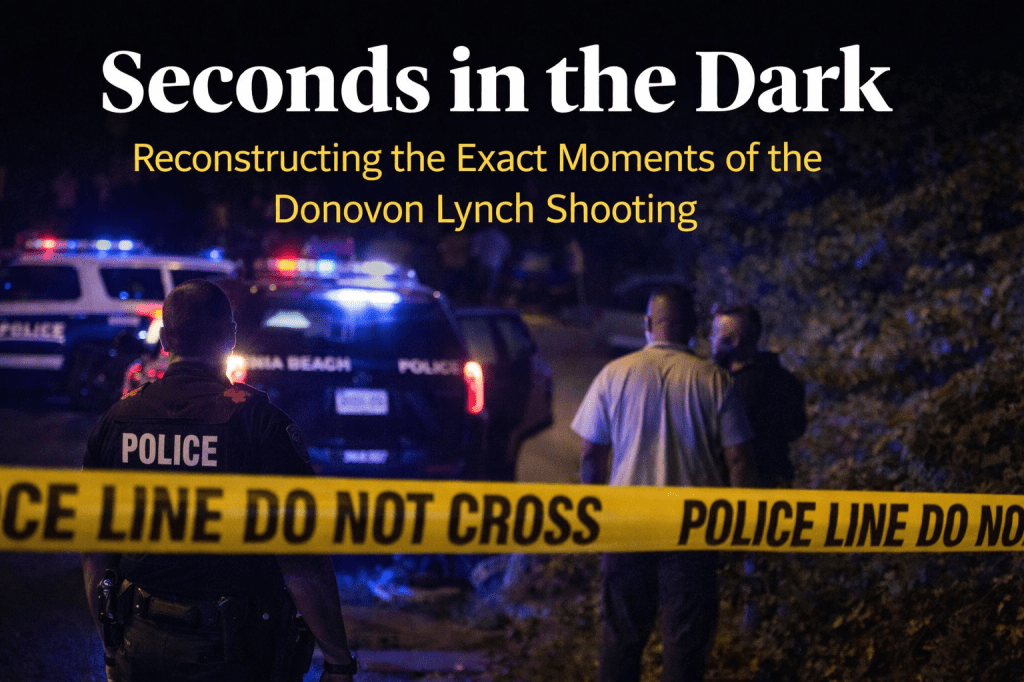
In the killing of Donovon Lynch, the most critical window of time—the final seconds before Officer Solomon Simmons fired three shots—remains both the most consequential and the least documented.
There is no body camera footage of the shooting itself.
No clear visual record of Lynch’s actions.
No confirmed verbal commands captured.
What exists instead is a fragmented reconstruction:
- Audio from nearby body cameras
- A distant surveillance camera capturing muzzle flashes
- Officer statements
- Civilian witness testimony
- Expert analysis based on police practices
From these pieces, a clearer—but deeply troubling—picture begins to emerge.
I. The Timeline Before the Shooting: Calm Before Contact
The most reliable visual evidence of Donovon Lynch’s movements comes not from the officer who shot him—but from Officer Justin Buck’s body camera.
What Buck’s Camera Shows
- ~1:17 mark — Lynch and Darrion Marsh walk casually down Pacific Avenue
- They pass multiple officers, including Buck
- No officer reacts as if Lynch poses a threat
- ~1:32 mark — Lynch and Marsh stop on a street corner
- They remain there for approximately one minute
- ~2:32 mark — Three gunshots are heard
- These are the shots fired by Officer Simmons
What This Establishes
This footage is critical for three reasons:
- Lynch was not acting erratically
- He was walking openly, not fleeing or hiding
- He passed police without incident
- Police did not perceive him as a threat
- Buck did not stop, question, or engage him
- There was a pause before the shooting
- Lynch and Marsh were stationary for about one minute
That one-minute gap is one of the most important—and least explained—intervals in the case.
II. The Environment: Chaos from Multiple Shootings
The shooting did not occur in isolation.
By the time Lynch and Marsh stopped at the corner:
- Multiple shootings had already occurred nearby
- Officers were responding to an active, evolving threat
- Gunfire had been reported across multiple locations
According to expert analysis, Officer Simmons had heard upwards of 40 gunshots before encountering Lynch.
This matters.
Because it reframes the encounter:
- Lynch was navigating chaos as a civilian
- Simmons was entering the same chaos as an officer
Both men were reacting to a volatile, uncertain environment—but with drastically different information.
III. Simmons’ Movements: Approach from the Rear
According to his own statements and investigative findings:
- Simmons exited his vehicle and proceeded on foot
- He was actively searching for a shooter
- He approached Lynch from the rear, slightly to the left side
He was not:
- Facing Lynch initially
- Announcing his approach from a distance
- Establishing a visible police presence
Instead, he closed distance quickly.
Kreitzman’s Position
Detective Brian Kreitzman was with Simmons:
- Also approached from Lynch’s left-rear
- Initially had his weapon drawn
- Then stopped and took cover behind a green electrical box
- Lowered his weapon as Simmons continued forward
This creates a divergence:
- Kreitzman slows, takes cover
- Simmons advances, exposed
That split-second tactical difference may have defined everything that followed.
IV. The Critical Failure: No Confirmed Identification
One of the most significant—and least disputed—facts in the case is this:
There is no evidence that Officer Simmons identified himself as police before shooting.
What the Record Shows
- Simmons said he “said something out loud”
- He could not recall what he said
- Kreitzman could not recall any commands
- No witness heard a clear police identification
- No audio captures any clear police identification or command—only a statement by Officer Simmons claiming the presence of a gun.
There is no:
- “Police, don’t move”
- “Drop the weapon”
- “Police” identification of any kind
Why This Matters
According to both:
- Virginia law, and
- Virginia Beach Police Department General Order 5.01
Officers are required to issue a warning when feasible before using deadly force.
The expert review concludes:
A verbal warning was not only feasible—it was necessary.
And more importantly:
Without identification, Lynch had no way to know he was encountering law enforcement.
IV.A. What the Audio Actually Captures — And What It Doesn’t
While no body camera captured the shooting visually, audio from another officer’s body camera does capture a critical moment:
Officer Simmons can be heard stating that there is a gun.
At first glance, that may appear to support Simmons’s account.
But the full context of that audio raises a more important issue:
The audio does not capture Simmons identifying himself as a police officer.
And that distinction is crucial.
What the Audio Confirms
- Simmons perceived the presence of a firearm
- He verbally acknowledged it
- The encounter was already escalating
What the Audio Does Not Confirm
- No “Police” identification
- No command such as “Drop the weapon”
- No warning prior to the use of deadly force
In other words:
The only captured statement reflects Simmons’s perception—not a communication directed at Lynch.
Why This Matters
If Simmons said “gun,” but did not say “police,” then from Lynch’s perspective:
- There was no clear authority identified
- No instruction to comply
- No opportunity to respond
Instead, the interaction—if it can even be called that—remained one-sided.
The officer perceived a threat.
But the civilian was never clearly informed:
- Who was approaching him
- What was being demanded
- Or that lethal force was imminent
A One-Way Encounter
This reinforces a central conclusion of the expert analysis:
The encounter did not function as a police command scenario—it functioned as a rapid, unilateral threat assessment followed immediately by gunfire.
And that distinction matters legally, tactically, and factually.
Because under both department policy and use-of-force standards:
A warning is not about what the officer perceives—it is about what the subject hears and understands.
IV.B. The “Gun” Narrative — When Did It Enter the Record?
Audio from another officer’s body camera captures Officer Simmons stating that there is a gun in the moments surrounding the shooting.
But that raises a critical—and often overlooked—question:
When did the claim that Donovon Lynch was pointing a gun first appear in official accounts?
The Timing Problem
Early public reporting in the immediate aftermath of the shooting did not clearly establish that Lynch had pointed a firearm at an officer.
The more specific claim—that Lynch:
- exposed a weapon
- manipulated it
- and pointed it at Officer Simmons
emerged later, as the official narrative developed.
That sequence matters.
Because it creates a gap between:
- what was initially communicated to the public, and
- what later became the central justification for deadly force
IV.C. Perception vs. Proof
The audio captures Simmons asserting the presence of a gun.
But that is not the same as proving:
- that the gun was visible
- that it was drawn
- or that it was pointed
The evidentiary record remains clear on this point:
- No body camera shows Lynch holding or raising a firearm
- No physical evidence establishes that he brandished it
- No gunshot residue indicates he fired it
- The only direct claim that he pointed a weapon comes from Officer Simmons
And that claim is contradicted by:
- Darrion Marsh, who stated Lynch never exposed the firearm
IV.D. Why the Distinction Matters
Saying “there is a gun” in a chaotic scene is not unusual.
But in this case, it becomes foundational.
Because the entire legal justification for the shooting depends on a much narrower claim:
Not that Lynch had a gun—but that he used it in a threatening way.
Without that, the justification collapses from:
- immediate lethal threat
to:
- presence of a legally carried firearm in a chaotic environment
And those are not the same thing.
IV.E. A Narrative That Hardened Over Time
When the timeline is viewed as a whole, a pattern begins to emerge:
- Initial uncertainty in early reports
- Later introduction of specific threat claims
- Reliance on officer recollection without video confirmation
At the same time:
- Key details are remembered (a gun, a movement, a perceived threat)
- Other critical details are not (what was said, whether police identified themselves)
That imbalance raises a fundamental question:
Why is the evidence strongest where it justifies force—and weakest where it would verify procedure?
V. Lynch’s Perspective: A Civilian in a War Zone
From Lynch’s position, the situation looks very different.
What did he know?
- There had been ongoing gunfire
- The environment was unstable
- People were moving unpredictably
What did he not know?
- That police were approaching him
- That he was being perceived as a threat
- That lethal force was seconds away
The expert conclusion is direct:
“In all likelihood, Mr. Lynch was not aware that police were the persons approaching him.”
This is not a minor detail.
It is the difference between:
- A suspect resisting police
- A civilian reacting to unknown movement in a violent environment
VI. The Moment of Contact: Seconds, Not Dialogue
According to Simmons:
- He observed Lynch crouched near bushes
- Claimed Lynch was manipulating a firearm
- Claimed Lynch rose and turned toward him with the weapon
At that moment:
- Simmons fired three shots
But this version faces critical problems.
VII. The Evidence Gap: No Proof of Brandishing
There is no physical evidence that Lynch:
- Drew his weapon
- Pointed his weapon
- Fired his weapon
What we do know:
- Lynch legally possessed a firearm
- The weapon had a round chambered
- No gunshot residue was found on him
Witness Contradiction
Darrion Marsh, standing with Lynch, stated:
Lynch never exposed his firearm at all.
There is no video evidence contradicting this.
There is no independent witness confirming Simmons’ claim.
VIII. Kreitzman’s Line of Sight Problem
Detective Kreitzman presents a critical inconsistency.
- He took cover behind an electrical box
- Lowered his weapon
- Did not advance with Simmons
Yet later:
- Claimed Lynch exposed a firearm
This raises a key question:
From behind cover, at an angle, during a chaotic nighttime event—what could he actually see?
There is no clear answer in the record.
IX. The Tactical Breakdown: Time, Distance, Cover
The expert analysis identifies three core policing principles:
- Time
- Distance
- Cover
Kreitzman used them.
Simmons did not.
What Simmons Did
- Closed distance rapidly
- Did not use available cover
- Did not slow the encounter
What That Eliminated
- Time to assess
- Time to communicate
- Time for Lynch to comply
Instead, the encounter compressed into seconds.
X. The One-Minute Gap: The Missing Narrative
One of the most important unanswered questions remains:
What happened during the one minute between Buck’s footage and the gunshots?
We know:
- Lynch and Marsh were stationary
- Simmons was moving toward them
- No confrontation is recorded
But we do not know:
- When Simmons first saw Lynch
- How quickly he approached
- What Lynch perceived in those final seconds
That missing minute is the blind spot at the center of the case.
XI. Not Mistaken Identity — A Deliberate Decision
This was not a case of mistaken identity.
- Simmons never claimed confusion
- He explicitly identified Lynch as the threat
- Lynch’s physical stature made misidentification unlikely
This was:
A conscious decision based on perceived threat.
Which brings the case to its central conflict:
- Simmons claims Lynch pointed a gun
- No evidence proves that occurred
XII. The Core Question: What Happened in Those Seconds?
Everything comes down to a moment that no camera captured.
A man standing on a corner.
An officer approaching from behind.
No confirmed identification.
No confirmed warning.
And then:
Three shots.
XIII. What the Evidence Suggests
When the pieces are assembled, a pattern emerges:
- Lynch was not behaving as a threat minutes before
- Police nearby did not react to him
- Simmons approached from behind
- No clear identification was given
- No warning was confirmed
- No physical evidence shows Lynch brandished a weapon
- The only claim of threat comes from Simmons
And critically:
The encounter unfolded so quickly that Lynch may never have understood what was happening.
XIV. Conclusion: A Shooting Without a Clear Moment of Justification
The only recorded statement from Officer Simmons in the moments surrounding the shooting is not “Police”—it is a claim about a gun, a claim that did not clearly appear in the earliest accounts and remains unsupported by physical evidence.
Yet, the legal system has already answered one question:
- The shooting was ruled justified
But the evidentiary record leaves another question unresolved:
What exactly happened in the seconds before the trigger was pulled?
Because without:
- Video
- Verifiable commands
- Physical proof of a threat
The justification rests almost entirely on one account.
And that account stands alone.
 The Donovon Lynch Case