Introduction
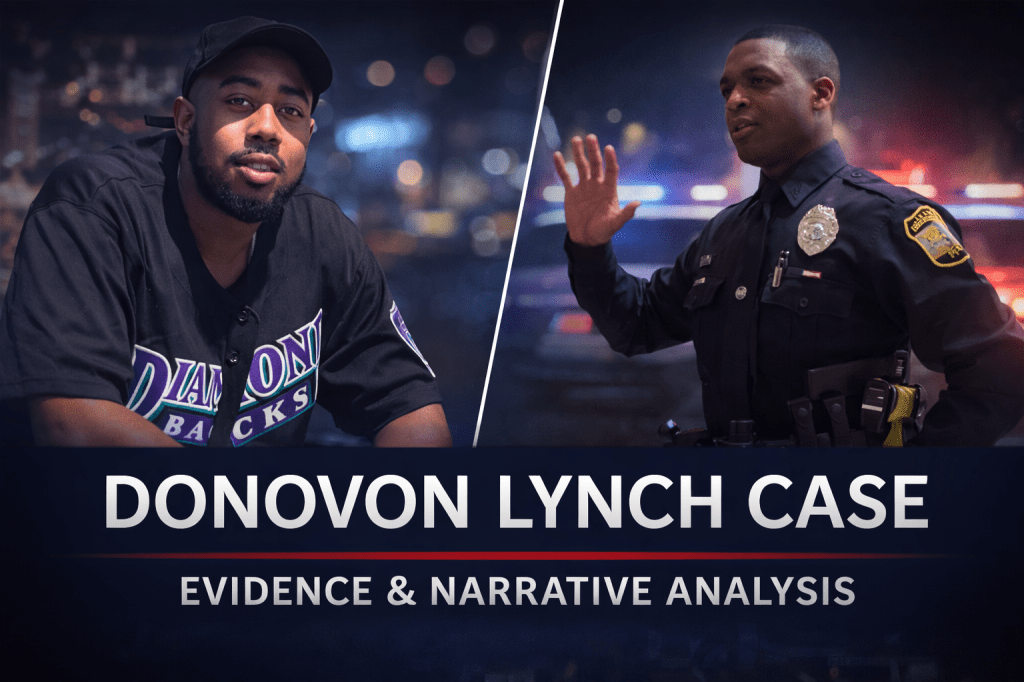
On the night of March 26, 2021, amid multiple shootings at the Virginia Beach Oceanfront, Officer Solomon Simmons shot and killed 25-year-old Donovon Lynch.
The official justification has remained consistent: Simmons claimed that Lynch turned toward him and pointed a firearm, creating an immediate threat that justified lethal force.
But beyond the officer’s account, a critical question remains:
What does the physical evidence actually show?
This analysis examines two central issues:
- Was there any physical evidence that Lynch pointed a gun?
- Was there any forensic evidence, such as gunshot residue, indicating Lynch fired his weapon?
The answers are not just technical—they go to the heart of whether the official narrative is supported, contradicted, or simply unverified by the available evidence.
1. The Claim vs. The Evidence
Officer Simmons’s account hinges on a specific sequence:
- He hears what he believes is a firearm being racked
- He turns and sees Lynch crouched behind shrubbery
- Lynch stands and points a firearm in his direction
- Simmons fires in response
This is the only account that explicitly describes Lynch pointing a weapon at an officer.
The question is whether any physical or forensic evidence corroborates this claim.
2. No Physical Evidence That Lynch Pointed a Gun
There is no known physical evidence—no ballistic, positional, or forensic reconstruction—that establishes Lynch pointed a firearm.
No such evidence has been publicly documented in:
- Forensic reports
- Scene reconstructions
- Ballistic trajectory analysis
- Physical positioning evidence
There is also no indication of:
- Finger positioning analysis
- Weapon orientation reconstruction
- Laser or sight alignment evidence
- Any physical markers indicating aiming behavior
In cases involving disputed police shootings, investigators sometimes rely on:
- Bullet trajectories
- Officer positioning vs. suspect positioning
- Environmental impact evidence
Here, none of those appear to independently confirm Simmons’s account.
Bottom line:
The assertion that Lynch pointed a firearm is supported only by Simmons’s statement, not by physical evidence.
3. Gunshot Residue: A Critical Absence
One of the most important forensic findings in the case is this:
No gunshot residue (GSR) was found on Donovon Lynch.
Gunshot residue testing is commonly used to determine whether an individual has recently fired a weapon.
According to the expert review:
- Lynch had no detectable GSR on his hands or body
- There is no forensic indication he discharged a firearm
This finding carries significant weight.
Why GSR Matters
While not perfect, GSR testing is a standard forensic tool used to support or challenge claims that someone fired a weapon.
The absence of GSR suggests:
- Lynch likely did not fire his weapon that night
- There is no forensic support for active gun use by Lynch
Importantly, the officer’s justification does not require that Lynch fired—only that he pointed a weapon.
But the absence of GSR still matters because it:
- Undermines any implication that Lynch was actively engaged in gunfire
- Reinforces the lack of physical evidence tying him to the surrounding shootings
4. The Condition of the Firearm
Further complicating the narrative is the condition of Lynch’s firearm.
According to the forensic findings:
- The firearm was legally registered
- Lynch had a valid concealed carry permit
- The weapon still had a round chambered
There is no indication that:
- The weapon had been recently fired
- The weapon was discharged during the incident
This aligns with the GSR findings and reinforces a key point:
There is no physical evidence that Lynch used his firearm at all.
5. Witness Testimony: A Direct Contradiction
While physical evidence does not confirm Simmons’s account, at least one eyewitness directly contradicts it.
Darrion Marsh
Darrion Marsh, a longtime friend of Lynch who was walking with him at the time, stated:
- Lynch never exposed his firearm
- There was no visible display or pointing of a weapon
This is not a minor discrepancy—it directly challenges the core justification for the shooting.
Other Witness Context
- Todd Smith reported that Lynch, after being shot, asked:
“Why did you shoot me?” - Kelvin Jones was present and assisted Lynch after the shooting but did not provide a recorded account supporting Simmons’s claim
- Detective Brian Kreitzman, another officer on scene:
- Took cover behind an electrical box
- Could not recall what commands were given
- Did not provide a confirming account of Lynch pointing a weapon
6. The Absence of Corroboration
In high-stakes use-of-force cases, investigators typically look for corroboration across multiple forms of evidence:
- Physical evidence
- Forensic analysis
- Officer testimony
- Civilian witness accounts
- Video or audio recordings
In this case:
| Evidence Type | Supports “Lynch Pointed a Gun”? |
|---|---|
| Officer Simmons statement | Yes |
| Physical / forensic evidence | No |
| Gunshot residue | No |
| Firearm condition | No |
| Civilian witness (Marsh) | Contradicts |
| Other witnesses | Do not confirm |
| Body camera footage | Not available at moment of shooting |
This creates a situation where the central claim is:
Uncorroborated by physical evidence and disputed by eyewitness testimony.
7. What This Means for the Narrative
This does not automatically prove that Simmons’s account is false.
But it does establish something equally important:
The justification for lethal force rests almost entirely on a single, unverified account.
There is:
- No forensic confirmation
- No physical reconstruction supporting the claim
- No independent witness corroboration
- At least one direct contradiction
And critically:
- No evidence that Lynch fired a weapon
- No gunshot residue
- No signs of active engagement in gunfire
8. The Larger Context: Chaos vs. Certainty
The shooting occurred during a chaotic night involving:
- Multiple active shooting scenes
- Large crowds
- Confusion among responding officers
This context matters.
Officer Simmons had:
- Already responded to another shooting
- Encountered multiple high-stress situations
- Entered an environment of perceived ongoing threat
In such conditions, perception and reality can diverge.
But that raises a deeper question:
When lethal force is justified based on perception alone, what level of evidence is required afterward to confirm that perception was accurate?
Conclusion
The available evidence leads to two clear findings:
1. There is no physical or forensic evidence that Donovon Lynch pointed a gun.
- No reconstruction
- No trajectory evidence
- No physical confirmation
2. There is no forensic evidence that Lynch fired his weapon.
- No gunshot residue
- No signs of discharge
- Firearm remained loaded and unused
At the same time:
- The only claim that Lynch pointed a gun comes from Officer Simmons
- That claim is contradicted by at least one eyewitness
- And it is not independently verified by any physical evidence
The Unresolved Question
At the center of the case is a gap:
Not just in evidence—but in certainty.
If no physical evidence confirms the threat, and available testimony conflicts, what standard of proof should determine whether lethal force was justified?
That question remains unanswered.
 The Donovon Lynch Case